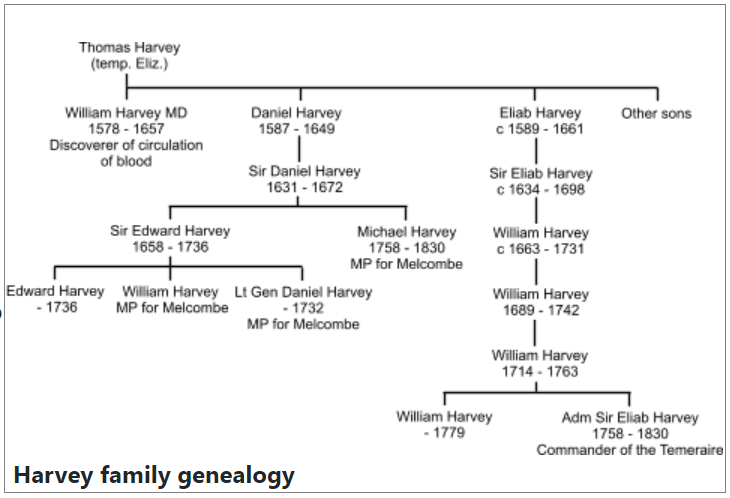
For a detailed account of the various members of the Harvey family and the collection of 13 portraits (the ‘Betchworth Portraits’), please refer to this informative paper by Alex Sakula.
Thomas Harvey, William’s father, was from Folkestone, where he was a successful ‘Turkey Merchant’ (a member of the Levant Company, formed in 1581 to conduct English trade with Turkey and the eastern Mediterranean). He served as Folkestone’s mayor in 1600.
William’s younger brother Eliab, who built on his father’s commercial success as a merchant, bought considerable estates in Essex and elsewhere, including Rolls Park in Chigwell and, in 1647, the Hempstead Estate. This included Wincelow Hall, which the family used as a country home.
But although to the Harveys of the 17th and 18th centuries, Hempstead was the location of just one of the family’s country houses and estates, it clearly held a special place. In 1655, Eliab selected its church, St Andrews, as the location for the family vault.
We focus here on the two best known members of the Harvey family : William Harvey, the celebrated physician and Admiral Sir Eliab Harvey, born 180 years later, who fought with Nelson at Trafalgar.
Dr William Harvey
William Harvey (1578-1657) was the first known physician to provide a detailed description of the circulation and properties of blood being pumped to the brain and the rest of the body by the heart.

William was born and educated in Folkestone and Canterbury, and graduated from Gonville and Caius College, Cambridge in 1597. After travelling through France, Germany and Italy, he entered the University of Padua from which he graduated as a Doctor of Medicine in 1602, at the age of 24. While in Padua, Harvey was tutored by the great scientist and surgeon Hieronymus Fabricius
After graduating from Padua, Harvey returned to England and obtained another doctorate in Medicine from Cambridge, becoming a fellow of his old college. Following this, he established himself in London, joining the Royal College of Physicians in 1604.
A few weeks after his admission to the RCP, Harvey married Elizabeth Browne, the daughter of another doctor, Lancelot Browne. They had no children.[
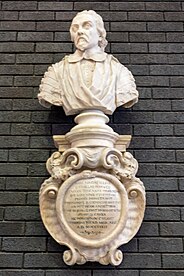
In 1615, Harvey was appointed by the RCP as its Lumleian lecturer – a seven year appointment with the purpose of ‘spreading light’ and increasing the knowledge of general anatomy. He continued to practise at St Bartholomew’s hospital and developed a lucrative practice which culminated in his appointment as ‘Physician Extraordinary’ to James I.
In 1628, Harvey published De Motu Cordis (‘On the Movement of the Heart), a treatise on the circulation of the blood which he dedicated to the new king, Charles I. The work, which flew in the face of contemporary wisdom derived from the Greek physiologist Galen, was received with great interest in England although the receoption in Europe was more sceptical.
In 1632, Harvey was appointed as physician to Charles I. He maintained this position through the Civil War, which took him to the royalist headquarters in Oxford where he became a Doctor of Physic and later Warden of Merton College. After the surrender of Oxford in 1645, he gradually withdrew from public duties and returned to London. He died from a cerebral haemhorrage at his brother’s house in Roehampton on 3 June 1657.
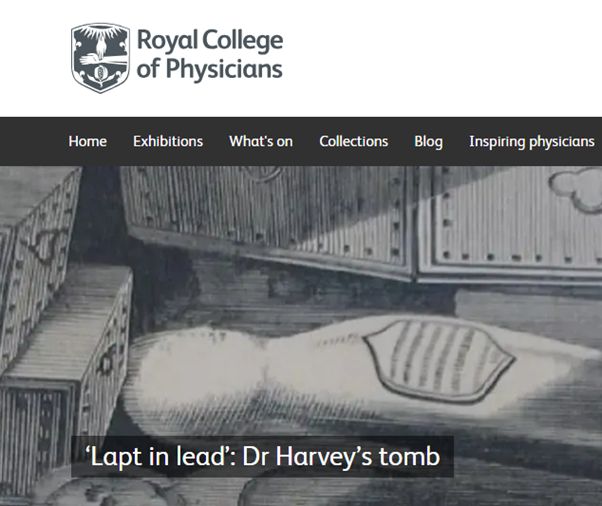
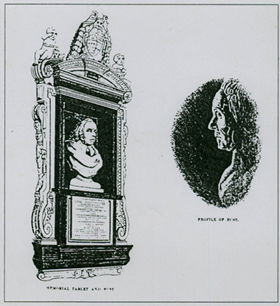
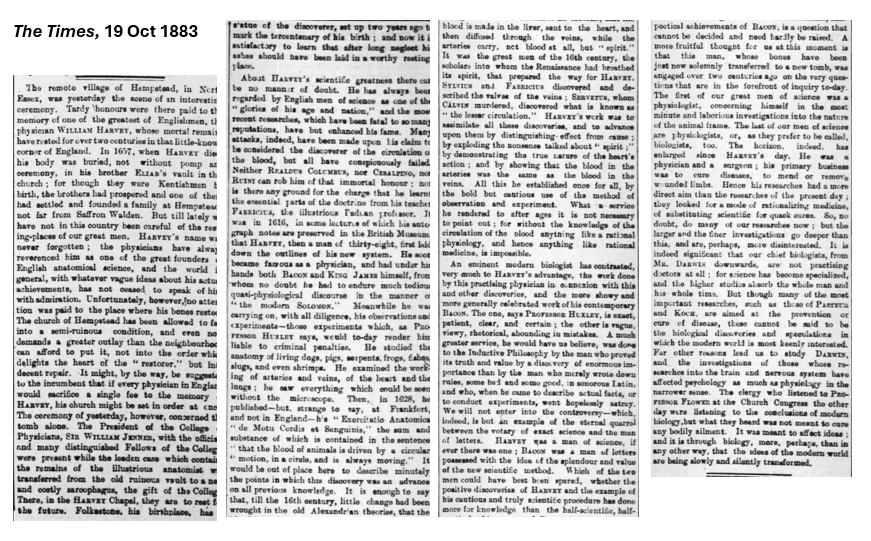
Harvey was buried in St. Andrew’s Church, Hempstead. His body was laid in the family chapel built by his brother Eliab, between the bodies of his two nieces. It was ‘lapt in lead’, simply soldered, without shell or enclosure of any kind. On 18 October 1883 (the day of St Luke, the patron saint of doctors) his Harvey’s remains were reinterred. The leaden case was carried from the vault by eight Fellows of the RCP and deposited in a sarcophagus containing a copy of his magnum opus.
This ceremony took place only a year after the disastrous collapse of the church tower. The Times, in an extensive report and eulogy to Harvey the following day, commented somewhat harshly on the church having been “allowed to fall into a semi-ruinous condition” and suggested that “if every physician in England would sacrifice a single fee to the memory of Harvey, the church might be set in order.” In the eent, this was to take another 80 years.
Read the full Times article on the ceremony and William Harvey here
“From his discovery has grown a mighty tree of knowledge, fruitful of blessings to mankind. His vision, his patient searching penetrated the darkness of centuries of error. He had to his hand no new aids or method. From within, or through himself, came the new spirit which found truth and set it forth.
No darkness can be as great as that of established authority. Time gives it the appearance, acceptance and sanction of truth. To attack it becomes first and impiety, then an offence. During the centuries, the influence of Galen had become so paramount as to forbid thought. Thus the lamp delivered by the ancients became extinguished. Harvey unfolded his discovery with convincing directness and restraint. A few pages contained the refutation of nineteen centuries of tradition and error. Despite ridicule, disparagement and even damage, he implanted the new knowledge with courageous yet courteous insistence. He preached that Nature must be pursued ‘through assured ways till they reached her in the citadel of truth and in such pursuits it is sweet not merely to toil but to grow weary.’
There belongs to Harvey a distinction rare among those great men who are makers of epochs, in that there has come down to us knowledge not only of his discovery but of the man himself – ‘he, being dead, yet speaketh’. The spirit of his teaching, his inspiration, his sense of friendship, are living forces today within the profession of medicine. It is not only a memorial – for Harvey needs not such, he already belongs to the immortals – it is also the fulfilment of a desire, a piety, to preserve in the minds of men, the association of his life and pilgrimage.”
Lord Dawson of Penn, GCVO KCB KCMG, President of the Royal College of Physicians, at the laying of the foundation stone for the new tower of St Andrews on 14 July 1933.
Other resources about William Harvey




Admiral Sir Eliab Harvey

Admiral Sir Eliab Harvey GCB (1758 – 1830) was a significant naval figure for over twenty years. His reputation is principally derived from his experiences at the Battle of Trafalgar in 1805.
Prior to the battle, Harvey’s ship HMS Temeraire was attached to the Channel Fleet, blockading ports in eastern France. When the battle was joined on 21 October, Harvey’s was the second ship in Nelson’s division and was faster and more agile than Nelson’s HMS Victory. As the division closed on the Franco-Spanish fleet, Temeraire began to pull ahead of Victory and Harvey was (it is claimed) reprimanded by Nelson: “I will thank you Captain Harvey, to keep your proper station, which is astern of the Victory“. Whether or not this is true, Harvey’s actions in foring his way between two French ships of the line certainly brought about their surrender. Characteristically, Harvey later created his family motto ‘Redoutable et Fougueux’ from the names of these ships.
Harvey – an eccentric and hot-tempered character distinguished as much for his gambling and duelling as for his military record – was not universally popular with his fellow officers. Once the Trafalgar fleet had returned to port, controversy erupted concerning Harvey’s role in the battle and the prominence which Admiral Collingwood had given it in dispatches. As a result, Harvey was promoted to rear-admiral and given the honour of being one of the pallbearers at Nelson’s funeral. His new motto and his penchant for ‘bragging’ further alienated him from his fellow officers.

last Berth to be broken up, 1838
by JMW Turner. National Gallery
Harvey was married and had numerous children; although he was survived by six daughters, his three sons all predeceased him. It seems that his brothers produced no issue, making him Eliab the last of the male line. As for Temeraire, she saw further action after Trafalgar but returned to Britain in 1813 and was converted to a prison ship in the River Tamar until 1819. After various other functions, the Admiralty ordered her to be sold in 1838, and she was towed up the Thames to be broken up.
One of Nelson’s Captains by George Caunt
Eliab’s entry in the Dictionary of National Biography
Reminiscences on Eliab’s Parliamentary career